The mention of India may conjure up many images in one’s head. Perhaps the splendour of the Mughal architecture or maybe the chaotic images of people clinging to trains. Few people not in the know would associate it with perhaps the world’s foremost literature festival. In fact the Jaipur Literature Festival has become somewhat of an institution, now in its 10th year and attracting more than a third of a million people for 5 days of talks, discussions, book launches, signings and readings.
This was my first visit to the festival (Aleks has been once before), and I was captivated by the whole thing. Much of the charm of the festival is the strange showy beauty of the venue. These intellectual talks take place in brightly patterned tents in a grand former palace converted to hotel. Gaudy decorations are draped everywhere, men in turbans ladle masala chai into earthen pots and the occasional tempting smell of Rajasthani cooking wafts over. Yes it may be over the top and somewhat for show, but it creates a magical effect and, despite the fact the grounds barely contain the crowds, presents a wonderful friendly introduction to India for a foreign guest.


There is not enough space in a single blog post to describe all the sessions we attended, although hopefully just by mentioning a few we can give an overview of the huge variety of fascinating talks offered: many had us scurrying to the bookshop tent immediately after, then running back to get the author’s signature.
The Girl with Seven Names
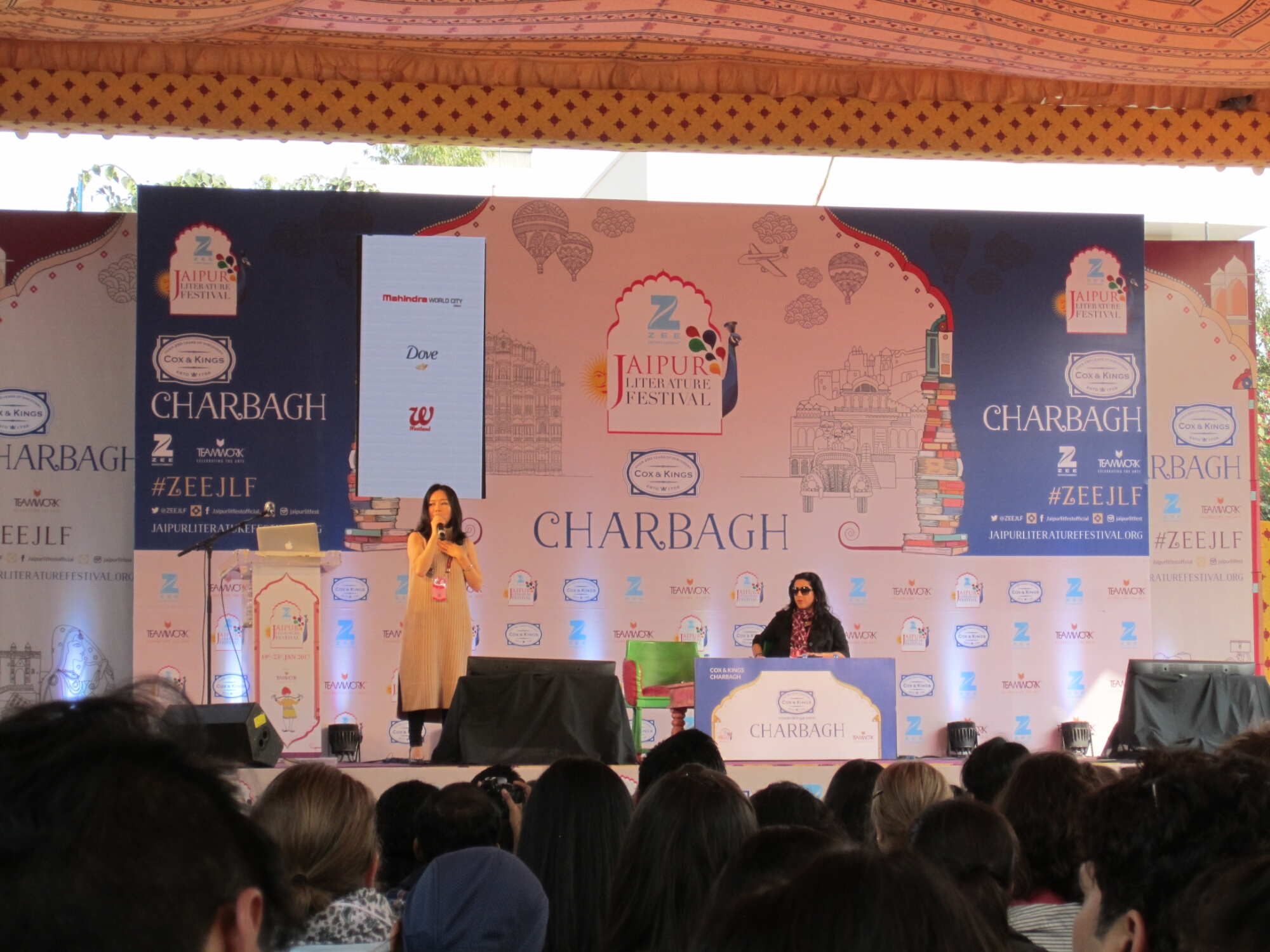
Hyeonseo Lee was curious about the world she saw in Chinese TV programmes she’d seen deflected from North Korea when she was only 17. One evening after dinner she told her mum she was going to a friend’s house. Instead she crossed the nearby border to China and it wasn’t until 14 years later that she saw her family again. Her story of what life is like in North Korea is chilling to the bone. She tells of self-criticism classes mandatory to all, run every Saturday where people are made to criticise their neighbours and friends. She tells of public executions for petty crimes of watching foreign content or going to China to bring food for starving family. She recalls how instead of attending lessons in middle school, her and her classmates were made to dig holes for anti-nuclear shelters to protect North Korea from American, Chinese and Japanese nuclear bombs. She remembers how when she was a child her house caught on fire and how her father ran into the flames to rescue their most prized possessions – portraits of the two leaders – and how he was congratulated for his valour by their neigbours. Perhaps the most scary thing about her story was that people in North Korea are made to belive that this is just what life is like and if they were to move anywhere else it would be even worse. Hyeonseo wrote a book about her life in North Korea and her life as a defector in China and South Korea, titled “The Girl with Seven Names”. You can also see a recording of a TED Talk she gave few years ago.
Kohinoor
An unexpected gem of a talk (awful metaphor fully intended), in this talk festival director William Dalrymple and Anita Anand gave a whistle-stop tour of the famous cursed diamond. From the early surfacing of the jewel as one of the stones in the Mughal Indian emperor Jahan’s jewelled throne the tale moves to Persia after the treasures of the Mughal Empire’s treasures are looted by Nader Shah. The Kohinoor becomes the foundation of Afghanistan after Shah’s assassination before being captured and returned to India where it is at the centre of a violent succession dispute. Taken from the hands of a child maharaja the Kohinoor came to London where it remains in the tower today. With more gore and plot-twists than a season of Game of Thrones, this talk was gripping from start to finish.
Murder, Madness and The Oxford English Dictionary
This was a talk about the fascinating story behind the Oxford Dictionary. As many of you probably know, The Oxford Dictionary of English is constantly evolving to reflect changes and new additions to the English language. What many probably not know about is that when the dictionary was first produced many of the words were provided by William Minor an American doctor, murderer and a lunatic (how he was then defined). Following his service in the American Civil War Minor unravelled, which eventually lead to him being committed to an asylum in Crawthorne, Berkshire. With all the time on his hands Minor become obsessed with finding words and examples of their usage for the dictionary and submitted thousands of them. You can read Simon Winchester’s book “Surgeon of Crawthorne” on the topic, available now or you can wait for the film featuring Sean Penn and Mel Gibson coming out soon.
One Child
As in her book, Mei Fong, a Chinese American author, opened her lecture with an account of the 2008 earthquake in Sichuan. Perhaps this may seem an odd place to start a conversation about China’s most controversial long-running social policy, but the links soon became apparent. At the epicentre of the earthquake was one of the original test zones for the policy, an area where single children were in abundance and, thanks to poorly built schools, an area which now contains many parents grieving the loss of their only child. A thoughtful lecture on the origins and effects of the one-child policy followed; conceived by rocket scientists (pretty much the only academics left after the cultural revolution), the issues of gender imbalance, family social care and the eventual need to reverse the policy never featured in the original plan. Now China is frantically trying to change, the voices of those like Mei Fong have never been more important.
The Dishonourable Company
This talk took me back to my final year at university, when I spent a lot of time studying the East India Company and their ventures in India. The talk covered the entire operational period of the Company and beyond, starting with the granting of the trading charter by Queen Elizabeth I in 1600 and going all the way to the Indian independence in 1947. It’s kind of hard to believe that in just one hour, such a vast period of time can be covered with time to spare for a discussion and Q&A session, but it worked rather neatly. The discussion panel consisted of Indian and British scholars, who despite having differing opinions about the East India Company all agreed on one point; that the Company was rather dishonourable (anyone familiar with this topic will know that the East India Company was often referred to as The Honourable East India Company).

 Daleks Abroad